

PHP2SHELL

PHP2Shell Campaign Intelligence: 15 Campaigns Tracked, Eight Activity Profiles Analyzed

Research focus: PHP2Shell exploitation attempts, K4nha botnet-kit C2, Sliver C2, custom Python tooling, cryptojacking-associated artifacts, and hosting infrastructure.

Executive Summary

PHP2Shell has brought renewed attention to the security of internet-facing PHP environments. However, the initial vulnerability is only one part of the investigation. The infrastructure, tooling, and activity surrounding exploitation attempts can provide additional evidence for defenders.

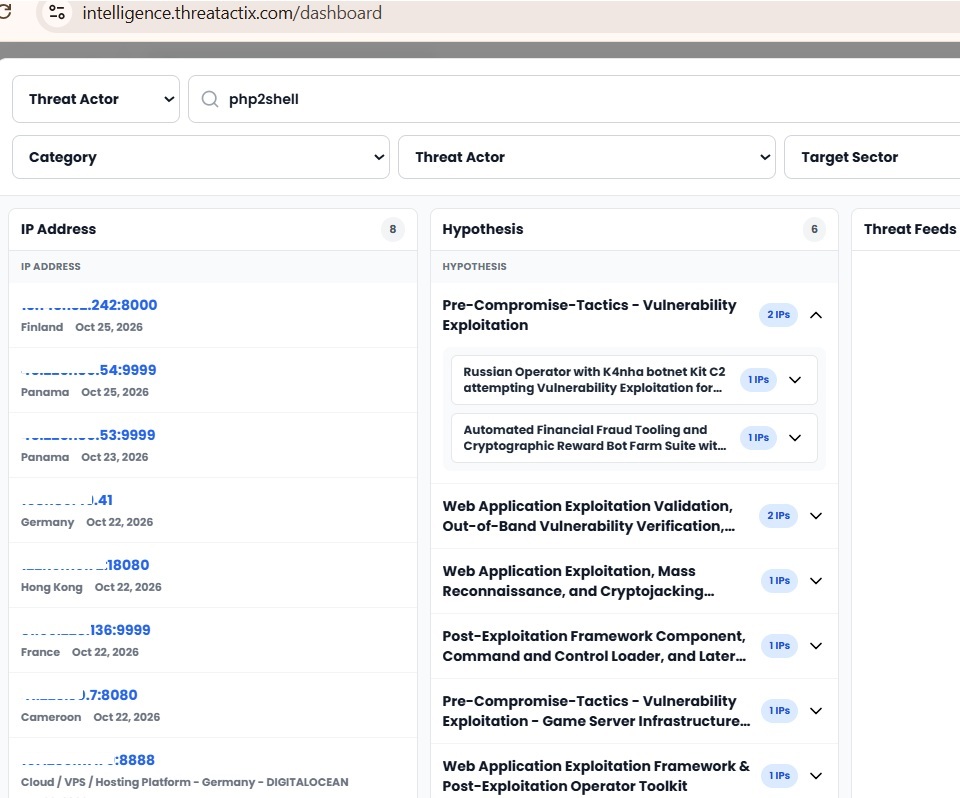
Threatactix is tracking 15 PHP2Shell-related campaigns, with telemetry spanning multiple activity patterns, including:

  1. K4nha botnet-kit C2 and European-region exploitation activity.
  2. Sliver C2, out-of-band validation, and SMTP authentication testing.
  3. Automated financial fraud and cryptocurrency reward-bot tooling.
  4. Java-related artifacts and cryptojacking-associated software.
  5. Adversary-emulation tooling and gaming-server infrastructure.
  6. Hosting, VPS/VDS, and anti-DDoS-related environments.
  7. A custom Python-orchestrated PHP2Shell C2 engine.

This report presents eight selected activity profiles from our current investigation, along with the relevant artifact categories and defensive hunting priorities.

The overview screenshot should show the overall campaign count and selected campaign relationships, with sensitive information redacted.

1. Vulnerability Context

PHP2Shell refers to two critical PHP vulnerabilities:

CVE

Vulnerability description

CVE-2026-109618

Memory corruption associated with out-of-memory handling during request processing

CVE-2026-109619

Use-after-free involving stale internal request state

Under affected conditions, these vulnerabilities can enable unauthenticated remote code execution. The flaws exist in the PHP runtime rather than necessarily in an individual application’s business logic.

The PHP project published fixes on October 21, 2026, including PHP 8.5.12, 8.4.27, 8.3.36, and 8.2.35. Organizations should verify the applicable vendor package and subsequent security updates.

Sources: PHP security advisory

2. Threatactix Telemetry: Eight Observed Activity Profiles

Profile 01 — K4nha Botnet-Kit C2 and European-Region Exploitation


Activity: PHP2Shell exploitation attempts | K4nha-associated tooling | Infrastructure discovery

Our telemetry describes an activity profile associated with a Russian operator and involving K4nha botnet-kit C2, with exploitation attempts across the European region.

The supplied artifact inventory includes K4nha kit archives, geographic datasets, probing utilities, fleet-discovery scripts, and associated output files.

Relevant artifact names
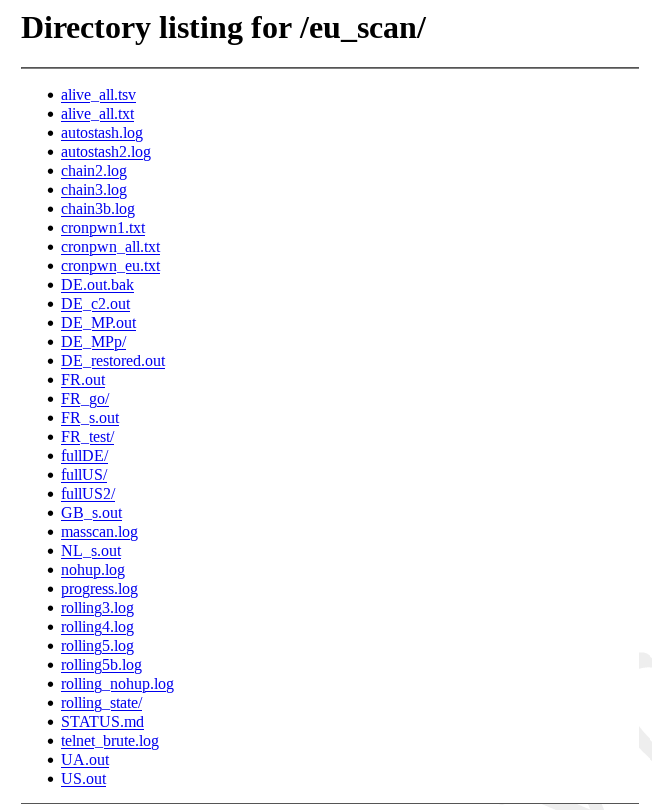
  1. eu_probe.py
  2. eu_chain*.sh
  3. kanha_kit_20261025.tar.gz
  4. kanha_kit_v2.tar.gz
  5. kanha_kit_v3.tar.gz
  6. kanha_takeover.tsv
  7. geo_scan and related output artifacts
Geographic and Infrastructure Context
 

eu scan

The supplied output inventory includes country-associated labels for Germany (DE), France (FR), the United Kingdom (GB), the Netherlands (NL), Ukraine (UA), and the United States (US). An additional file, cronpwn_eu.txt, refers to a European-region dataset.
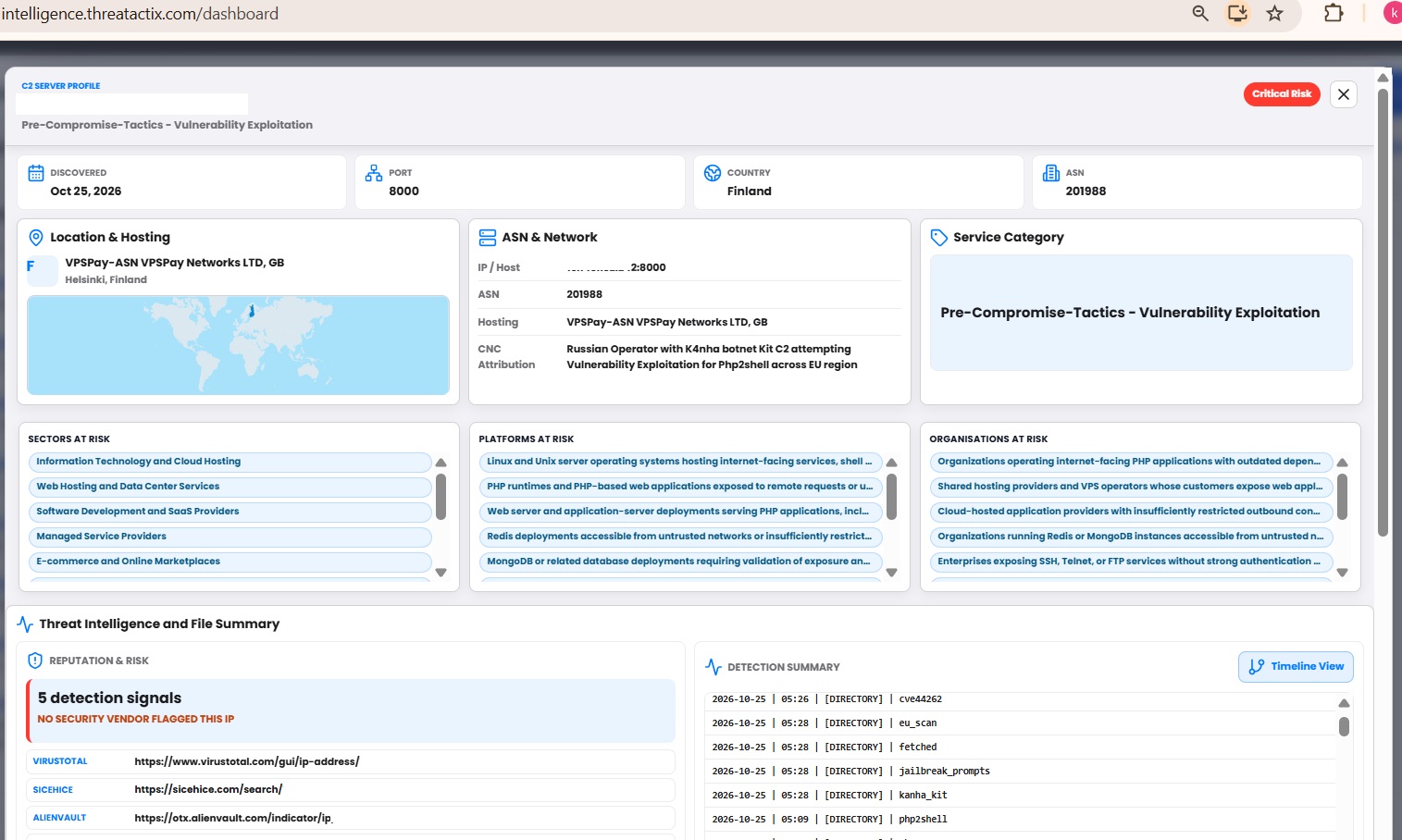
kanha-portal -1

 Campaign profile: K4nha Botnet-Kit C2

Hunting priorities

  1. Correlate suspicious PHP requests with endpoint and web-server telemetry.
  2. Investigate repeated probing and unexpected outbound connections.
  3. Review unusual process execution and application-file changes.
  4. Compare infrastructure observations across geographic datasets.

Profile 02 — Financial Fraud and Cryptocurrency Reward-Bot Tooling

Activity: Account automation | Financial fraud tooling | Web-shell-associated components

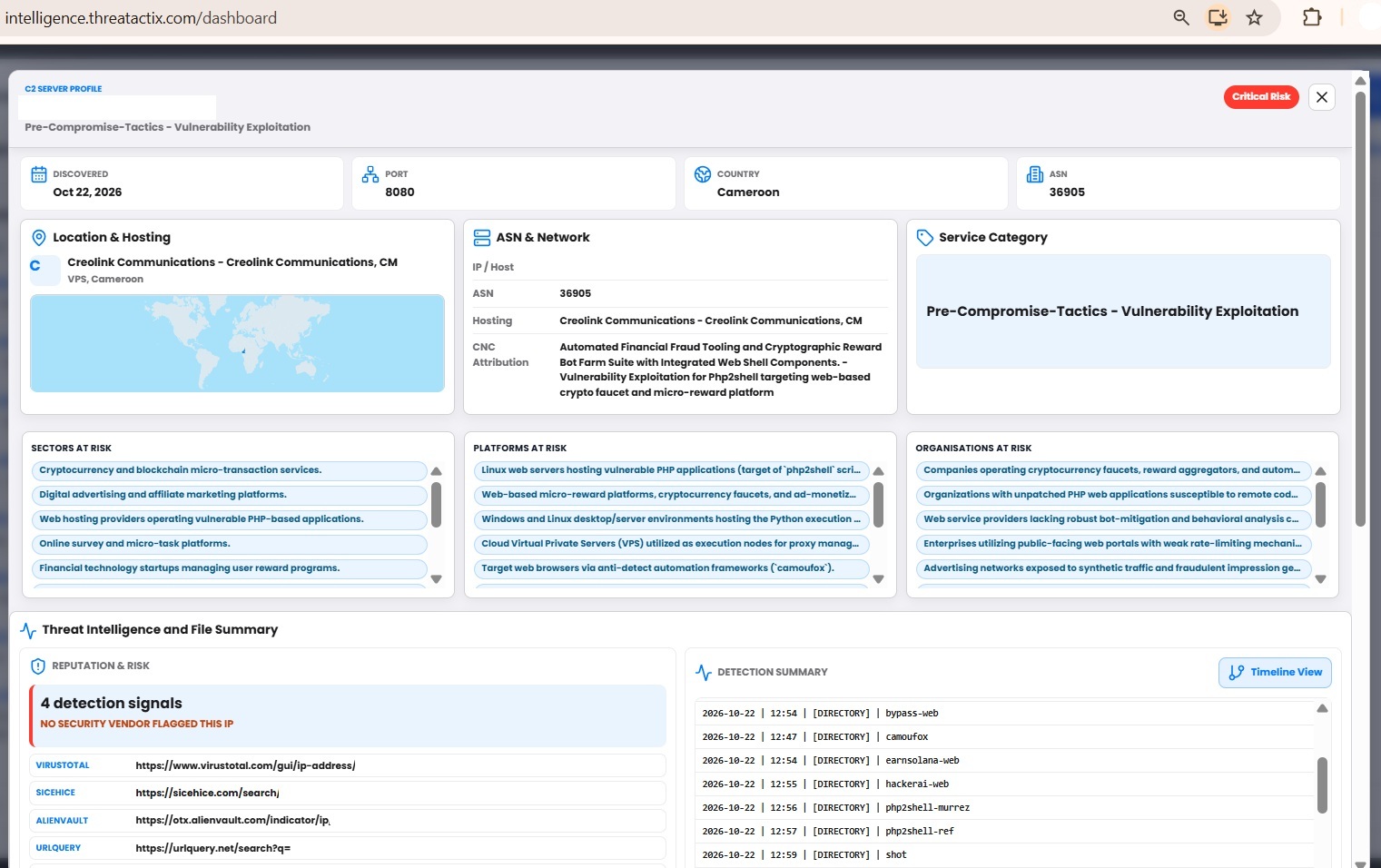
The supplied inventory contains reward-task automation, account-creation scripts, proxy-pool files, CAPTCHA-solving utilities, and platform-specific automation components.

The associated activity description identifies cryptocurrency faucet and micro-reward platforms as the target context.

Relevant artifact categories
  1. Reward and task automation scripts.
  2. Account-creation and platform automation components.
  3. Proxy-pool and CAPTCHA-solving artifacts.
  4. PHP2Shell-associated directories and application-testing files.

financial profile2

Campaign profile: Financial fraud tooling

Hunting priorities

  1. Identify anomalous account creation and repeated reward-related activity.
  2. Investigate suspicious application-file changes.
  3. Correlate web requests with unexpected process execution and outbound traffic.
  4. Check for unauthorized automation or potential abuse of application resources.

Profile 03 — Sliver C2, Out-of-Band Validation and SMTP Testing


Activity: PHP2Shell exploitation attempts | Sliver C2 | SMTP authentication and STARTTLS testing

The campaign description associates this activity with a Serbian actor. The supplied inventory contains PHP2Shell-related scanning and validation utilities, out-of-band callback components, Sliver client artifacts, and SMTP testing tools.

Together, these provide several investigative paths to correlate web activity with subsequent host and network behavior.
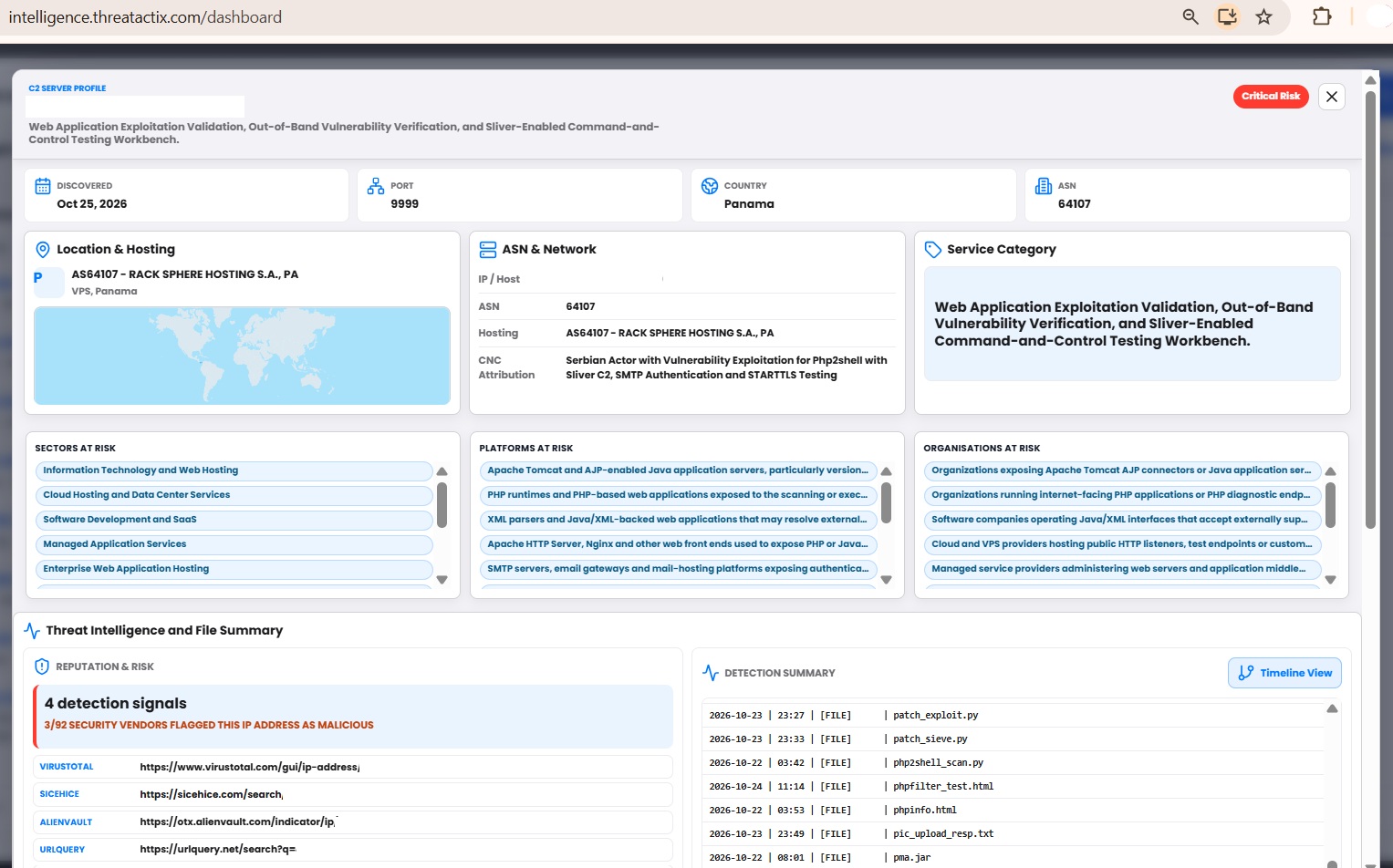
workbench-profile3

Campaign profile: Open Profile 03 — Sliver C2 and SMTP Activity

Hunting priorities

  1. Correlate suspicious web requests with callback events.
  2. Investigate unexpected processes and external connections.
  3. Review SMTP authentication and STARTTLS activity originating from web infrastructure.
  4. Establish whether the observed sequence resulted in execution or unauthorized access.

Profile 04 — Sliver C2: Similar Activity from a Separate IP


Activity: Exploitation attempts | Sliver C2 | SMTP and STARTTLS testing

A separate telemetry entry exhibits a pattern similar to Profile 03 but uses a different IP address.

The shared activity categories justify comparative analysis, but the two observations should remain distinct until the evidence supports clustering.
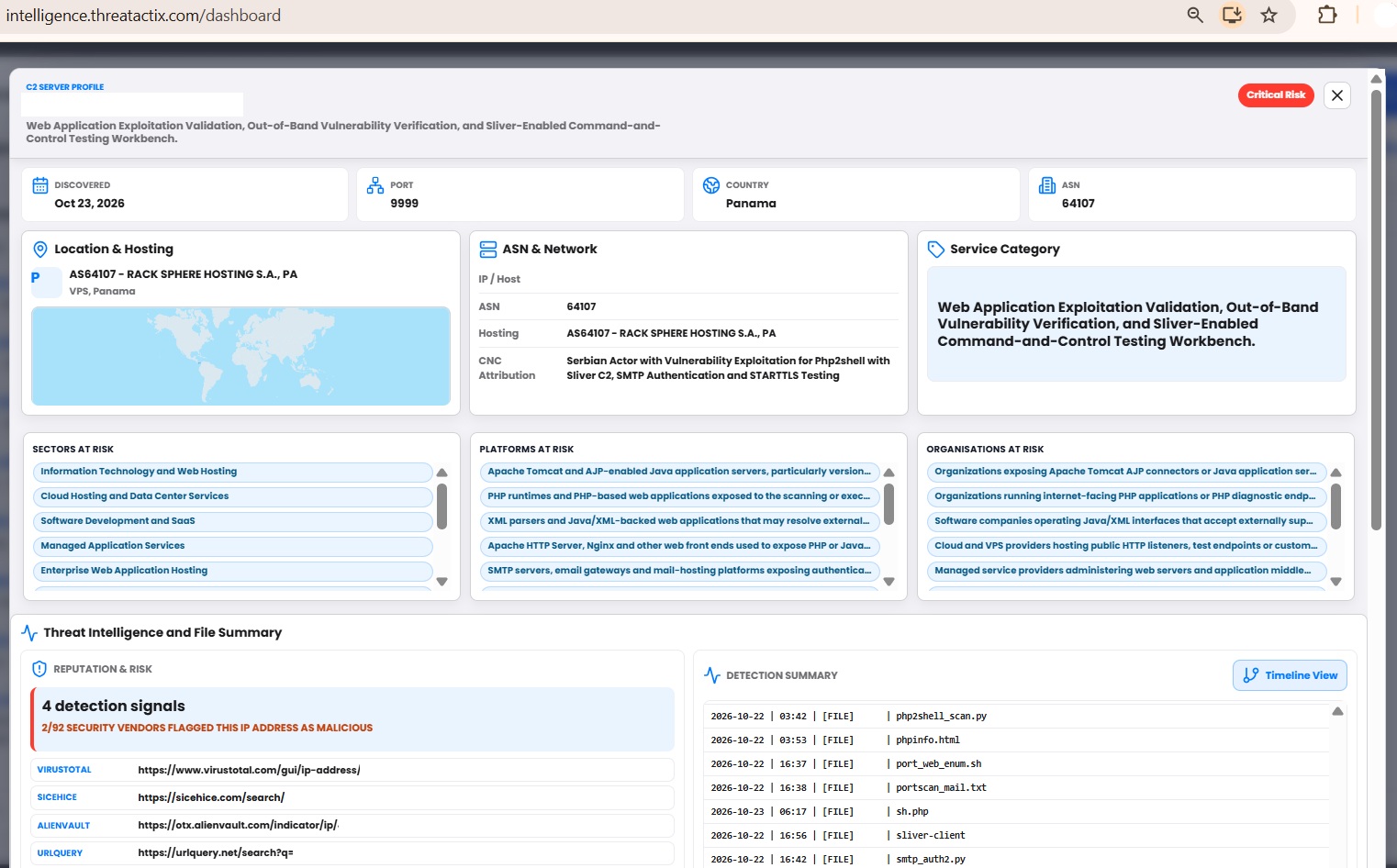
workbench sliver profile4

Campaign profile: Open Profile 04 — Separate-IP Sliver Activity

Hunting priorities

  1. Compare event timestamps and request characteristics.
  2. Correlate callback activity and outbound connection patterns.
  3. Examine supporting infrastructure and subsequent host behavior.
  4. Determine whether the activity is consistent with shared tooling or merely similar tradecraft.
  5.  

Profile 05 — PHP2Shell Workbench, Java-Related Artifacts and Cryptojacking


Activity: Exploitation tooling | Java archives | Cryptojacking-associated software

The supplied inventory includes PHP2Shell-related workbench directories, Java archive files, application-testing artifacts, and a directory named xmrig-6.26.0, associated by name with XMRig cryptomining software.

These artifacts warrant investigation into potentially unauthorized execution, resource abuse, and application compromise.

Relevant artifact categories: 
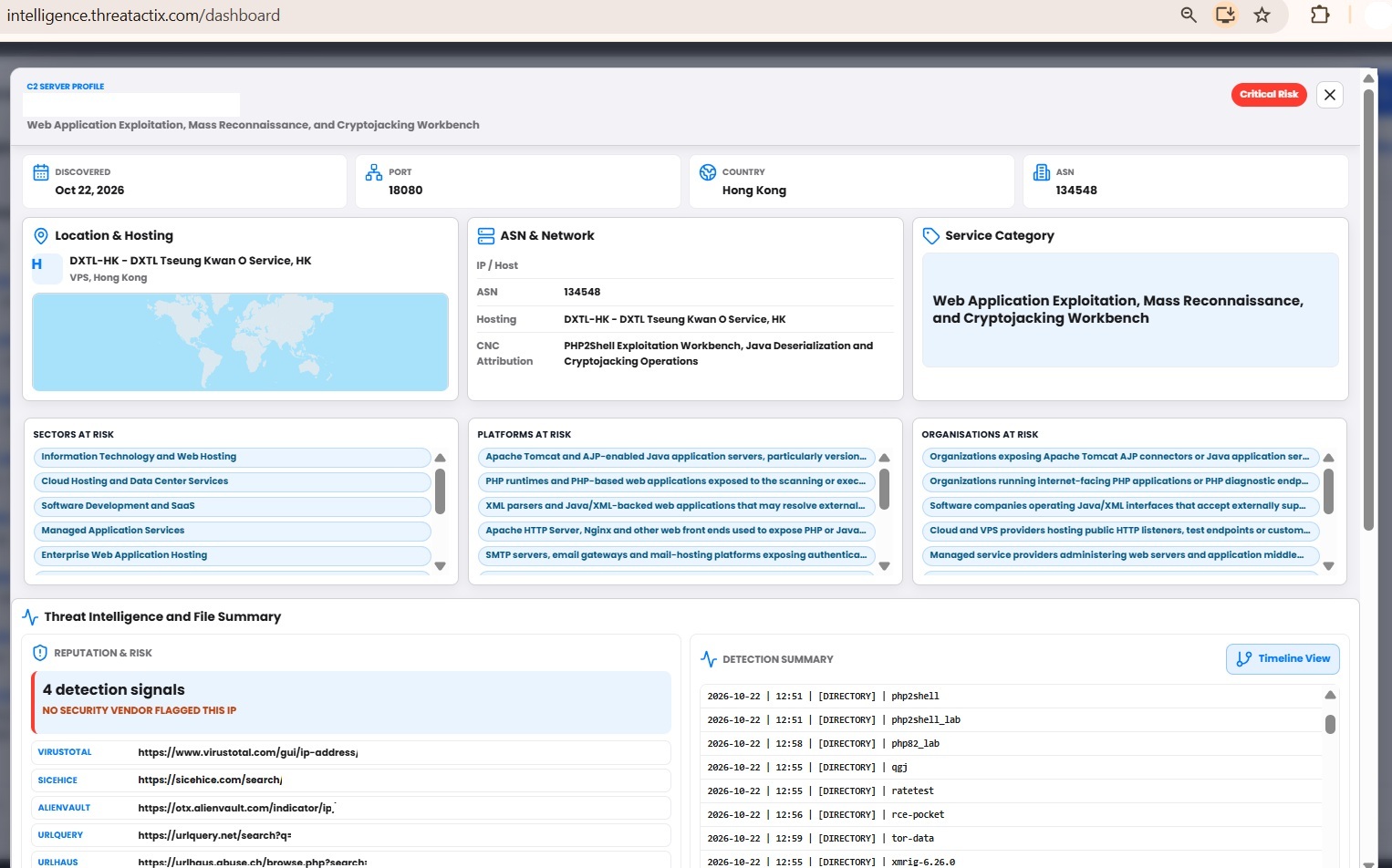
  1. php2shell and php2shell_lab directories.
  2. eviljar directory and Java archive files.
  3. xmrig-6.26.0 directory.
  4. PHP-related testing and diagnostic artifacts.
cryptojacking profile 5


Campaign profile:
Open Profile 05 — Exploitation and Cryptojacking Investigation

Hunting priorities

  1. Investigate unexpected PHP or Java process execution.
  2. Review unexplained CPU consumption and external connections.
  3. Check for unfamiliar executables and unauthorized application changes.
  4. Correlate process and resource activity with web-server and network telemetry.

Profile 06 — Adversary-Emulation Toolkit and Gaming-Server Staging


Activity: Security-testing tools | Post-exploitation-associated artifacts | Gaming infrastructure

The supplied inventory contains security-testing and post-exploitation-associated artifacts, including:
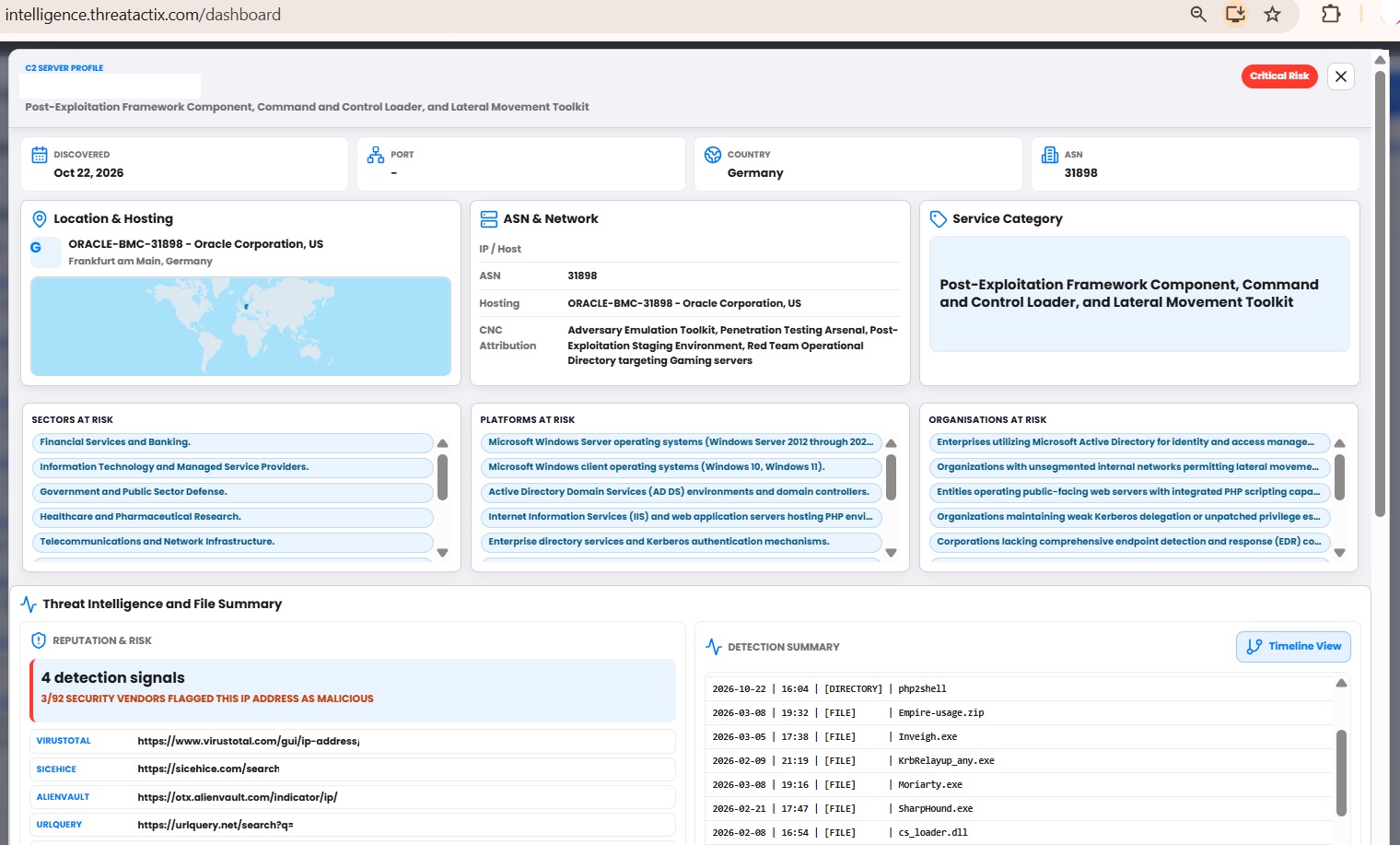
  1. Empire-usage.zip
  2. SharpHound.exe
  3. Inveigh.exe
  4. KrbRelayup_any.exe
  5. meterpreter.dll
  6. ncatStarter.exe

adversary toolkit profile 6

Campaign profile: Open Profile 6 – Adversary Emulation toolkit

Hunting priorities

  1. Validate whether tool deployment was authorized.
  2. Review file creation, process execution, and administrative events.
  3. Investigate unexpected staging directories and executables.
  4. Correlate suspicious activity with gaming-server access and network telemetry.

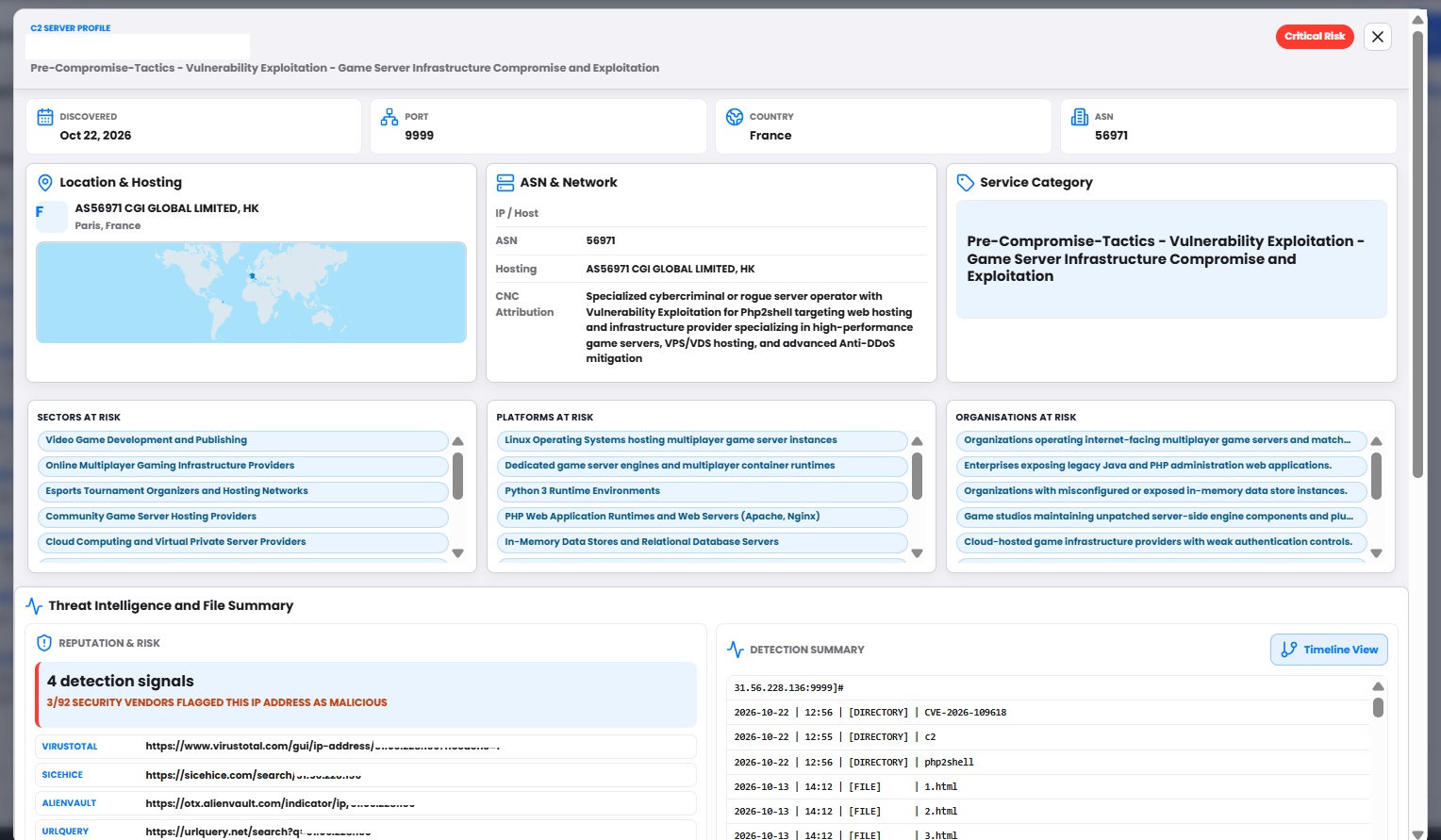
Profile 07 — Hosting, VPS/VDS and Anti-DDoS Infrastructure


Activity: PHP2Shell-related exploitation attempts | Hosting infrastructure | Potential unauthorized access

The supplied inventory describes a hosting-related environment associated with high-performance gaming servers, VPS/VDS services, and anti-DDoS infrastructure.

The inventory includes directories labelled CVE-2026-109618, c2, and php2shell, alongside application and server-management artifacts.

These observations provide leads for investigating potentially exposed services, suspicious administrative activity, and unauthorized changes.
profile 7

Campaign profile: Open Profile 07 — Hosting and VPS Infrastructure

Hunting priorities

  1. Identify the specific application and affected asset.
  2. Correlate suspicious requests with server and endpoint telemetry.
  3. Investigate unexpected processes, files, and persistence mechanisms.
  4. Distinguish customer-hosted activity from provider-level infrastructure activity.

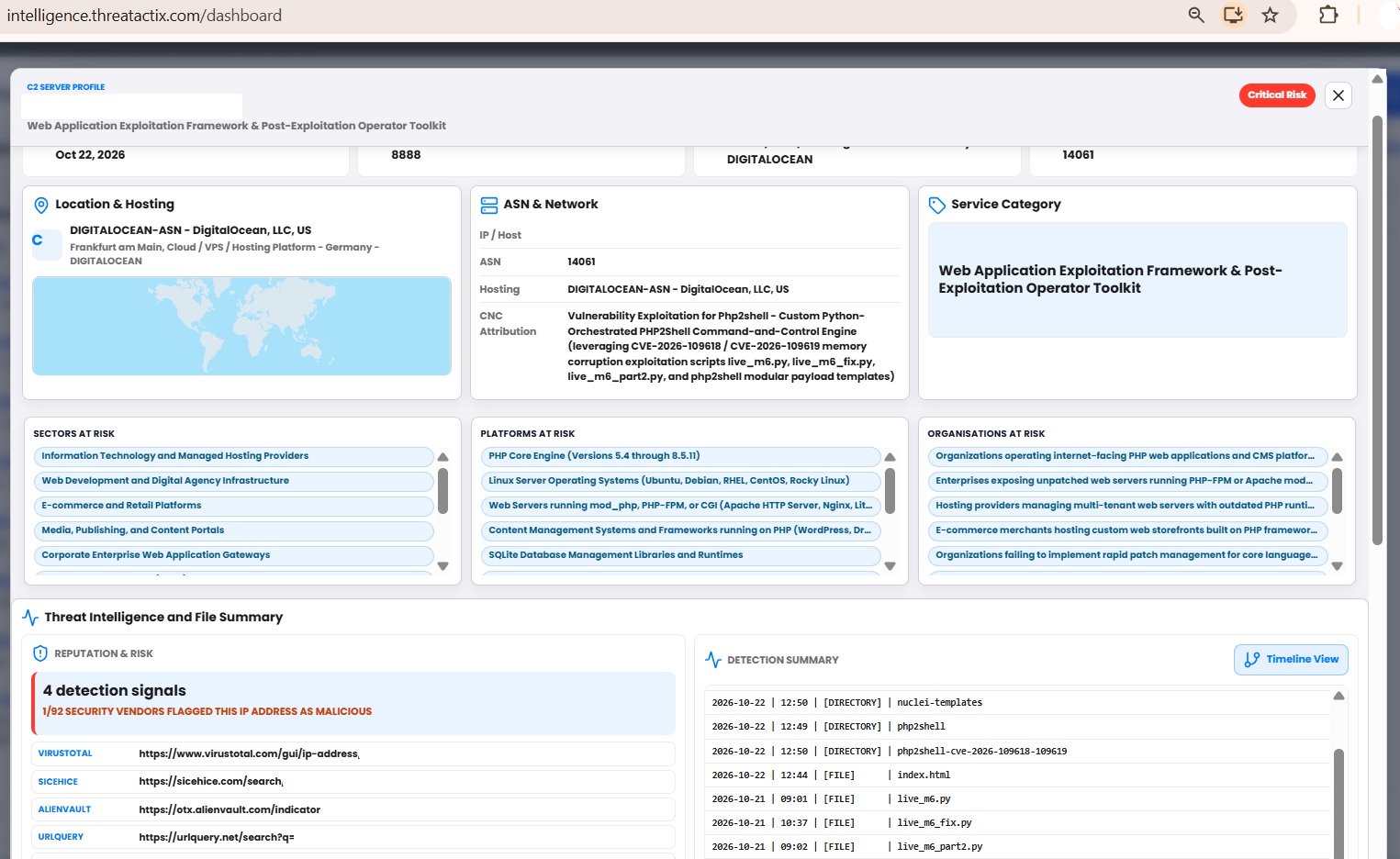
Profile 08 — Custom Python-Orchestrated PHP2Shell C2 Engine


Activity: Custom Python tooling | Exploitation-related activity | C2 investigation

The supplied inventory explicitly describes a custom Python-orchestrated PHP2Shell C2 engine associated with CVE-2026-109618 and CVE-2026-109619.

Relevant filenames include:

  1. live_m6.py
  2. live_m6_fix.py
  3. live_m6_part2.py
  4. php2shell-cve-2026-109618-109619

The inventory also contains Nuclei-template-related artifacts and versioned supporting materials.
profile 8

Campaign profile: Open Profile 08 — Python-Orchestrated C2

Hunting priorities

  1. Investigate unexpected Python execution on PHP-enabled servers.
  2. Correlate suspicious application requests with process and network activity.
  3. Review unexplained outbound connections and unusual child processes.
  4. Establish an incident timeline using validated timestamps and endpoint evidence.

3. Defensive Hunting Priorities

The profiles point to several practical areas for investigation.

Telemetry source

What to investigate

Web server and WAF logs

Suspicious requests, malformed multipart requests, repeated HTTP errors

PHP runtime and EDR

Unexpected child processes, PHP worker churn, unusual execution

File integrity monitoring

Unexpected PHP files, scripts, and application changes

DNS, firewall and proxy logs

Recurring destinations and unusual outbound connections

Mail-server logs

Unexpected SMTP authentication and STARTTLS activity

Host-performance telemetry

Unexplained CPU consumption and possible cryptomining

Persistence and configuration records

Unexpected services, scheduled tasks, and configuration changes

For PHP2Shell specifically, Wiz Research describes investigation signals including unusual multipart requests followed by memory-limit errors or repeated HTTP 500 responses, unexpected PHP worker churn, and anomalous session-cookie behavior. These are investigative leads rather than definitive indicators of compromise.

Reference: Wiz Research — PHP2Shell technical analysis.

Recommended Investigation Workflow

  1. Establish exposure. Inventory PHP installations, identify internet-facing assets, and verify patch status against the applicable vendor advisory.
  2. Correlate activity. Connect suspicious web requests with endpoint, process, DNS, and network records.
  3. Validate execution. Investigate unusual processes, unauthorized files, persistence, and unexplained outbound connections.
  4. Assess infrastructure relationships. Compare timestamps, behaviors, and supporting indicators before clustering separate IP addresses into one campaign.
  5. Respond and document. Preserve evidence, remediate affected systems, and convert validated observations into repeatable hunting procedures.

Patching is the priority. Where exploitation is suspected, patching should be accompanied by an investigation for evidence of prior compromise.

4 . What This Means for Security Teams

The eight profiles illustrate why a vulnerability alert is only the starting point for an investigation.

The activity descriptions span botnet-associated C2, Sliver-related infrastructure, automated financial fraud tooling, Java-related artifacts, cryptomining-associated software, gaming-server environments, hosting infrastructure, and a custom Python C2 workbench.

The practical challenge is connecting those observations to evidence: whether an exploit request succeeded, whether execution followed, which infrastructure was contacted, and whether the affected system requires incident response.

Threatactix is tracking 15 PHP2Shell-related campaigns and developing investigative context to support security teams in prioritizing suspicious infrastructure and turning observations into actionable threat-hunting workflows.

Access Threatactix Threat Intelligence


Explore the Threatactix Intelligence Portal for campaign-specific threat intelligence, attacker infrastructure insights, and actionable threat-hunting opportunities.

Explore the Intelligence Portal: https://intelligence.threatactix.com/

Request a PHP2Shell Intelligence Briefing: Contact Threatactix and mention PHP2SHELL to discuss campaign intelligence, relevant indicators, and available threat-hunting playbooks.

Uncover the infrastructure. Understand the campaign. Hunt what others miss.